
New Construction Homes in Liberty MO: What Buyers Need to Know

New Construction Homes in Liberty MO: What Buyers Need to Know
But here is what most buyers do not find out until they are already deep in the process: buying new construction is fundamentally different from buying a resale home. The contract is different, the process is different, the negotiation is different, and the risks are different. Buyers who walk into a model home without understanding those differences often end up paying more than they should, giving up protections they did not know they had, and making upgrade decisions that do not hold up to the math.
Liberty, MO, is one of the most active new construction markets on the Missouri side of the Kansas City metro right now. Builders are competing for buyers, new communities are developing, and the conditions are genuinely favorable for informed buyers who know how to use that leverage. The keyword is informed.
If you want to talk through what a new construction purchase in Liberty, MO, actually looks like before you walk into a model home, schedule a call here, and we will map it out together.
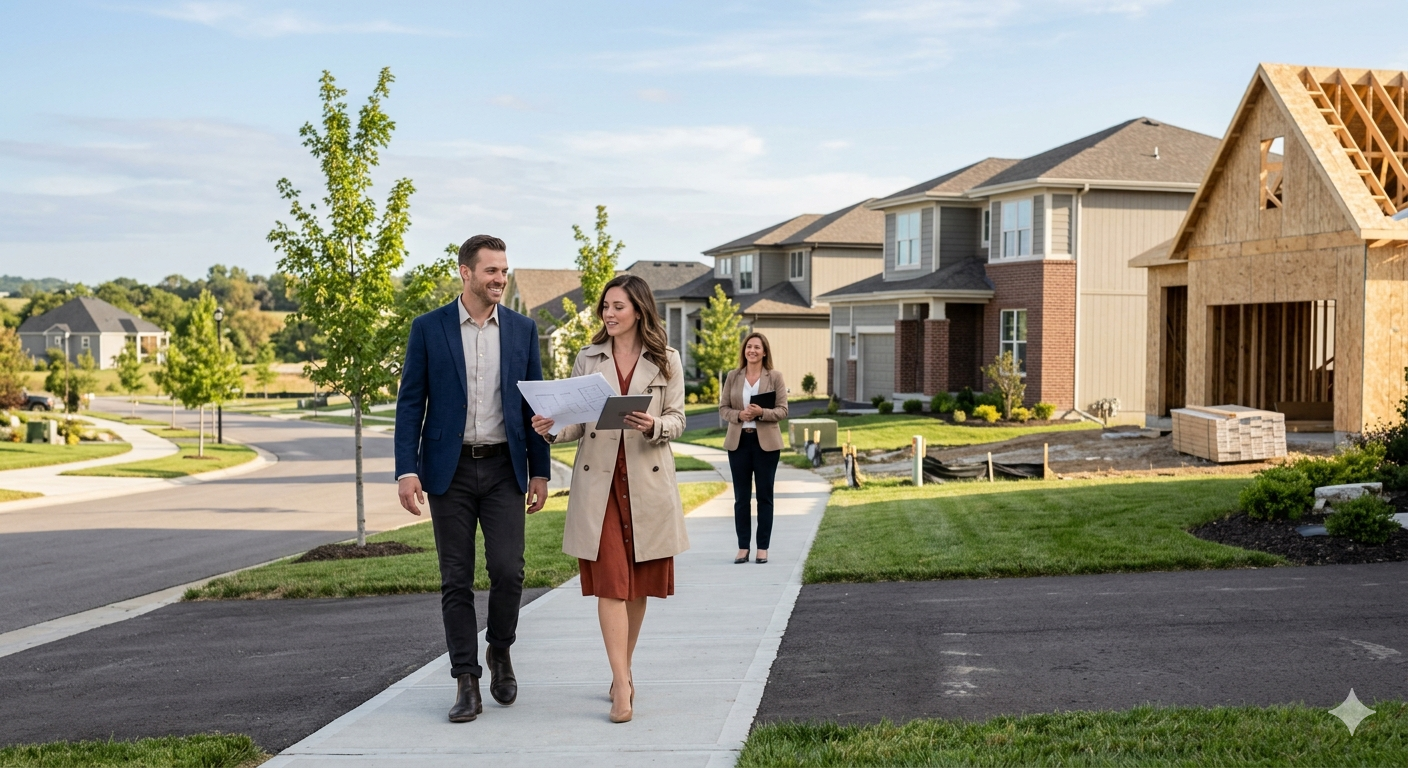
Why Liberty, MO, Is One of the Strongest New Construction Markets in Kansas City Right Now
Liberty, MO, does not get as much attention as Overland Park or Lee's Summit in the new construction conversation, but it probably should. The combination of what this market offers right now is hard to find anywhere else at the same price point on the Missouri side.
The school districts here are consistently rated among the strongest in the KC metro, which drives long-term demand and protects resale value in ways that matter to buyers thinking beyond their first few years in the home. Highway access to both downtown Kansas City and the broader metro is direct and practical for commuters. And the community growth trajectory, new retail, new infrastructure, and new residential development, signals a market that is still in an upswing rather than one that has already peaked.
Builders are active here specifically because buyer demand is sustained. That means more inventory to choose from, more builder competition, and more room for a prepared buyer to negotiate. The buyers who do best in this market are not the ones who fell in love with the first model they walked through. They are the ones who understood the landscape before they sat down across from a builder's sales representative.
Explore active Kansas City neighborhoods and new communities to see where Liberty fits in the broader metro picture.
The Builder's Sales Agent Works for the Builder, Not for You
This is the single most important thing to understand before you walk through a model home door, and it is the thing almost nobody tells buyers upfront.
The on-site sales representative in every new construction model home is employed by the builder. They are trained, professional, and genuinely helpful in many ways. They know the floor plans, the timelines, the upgrade packages, and the financing incentives inside and out. But their job, regardless of how the conversation feels, is to sell homes at the best possible price and terms for the builder. They are not your advocate. They cannot be. It is not their role.
What that means in practice is significant. The contract they hand you is the builder's contract, written by the builder's attorneys, structured to protect the builder's interests. The preferred lender they recommend is the builder's preferred lender, with a relationship that benefits the builder's transaction flow. The incentives they offer are structured to move inventory, hit sales targets, and maintain margin. All of that is legitimate business. But none of it is designed with your outcome as the primary objective.
The buyer who walks in alone, gets excited, and signs at the model home table is the buyer who finds out later what they agreed to. The buyer who walks in with a knowledgeable agent on their side is the buyer who reads the contract before signing it.
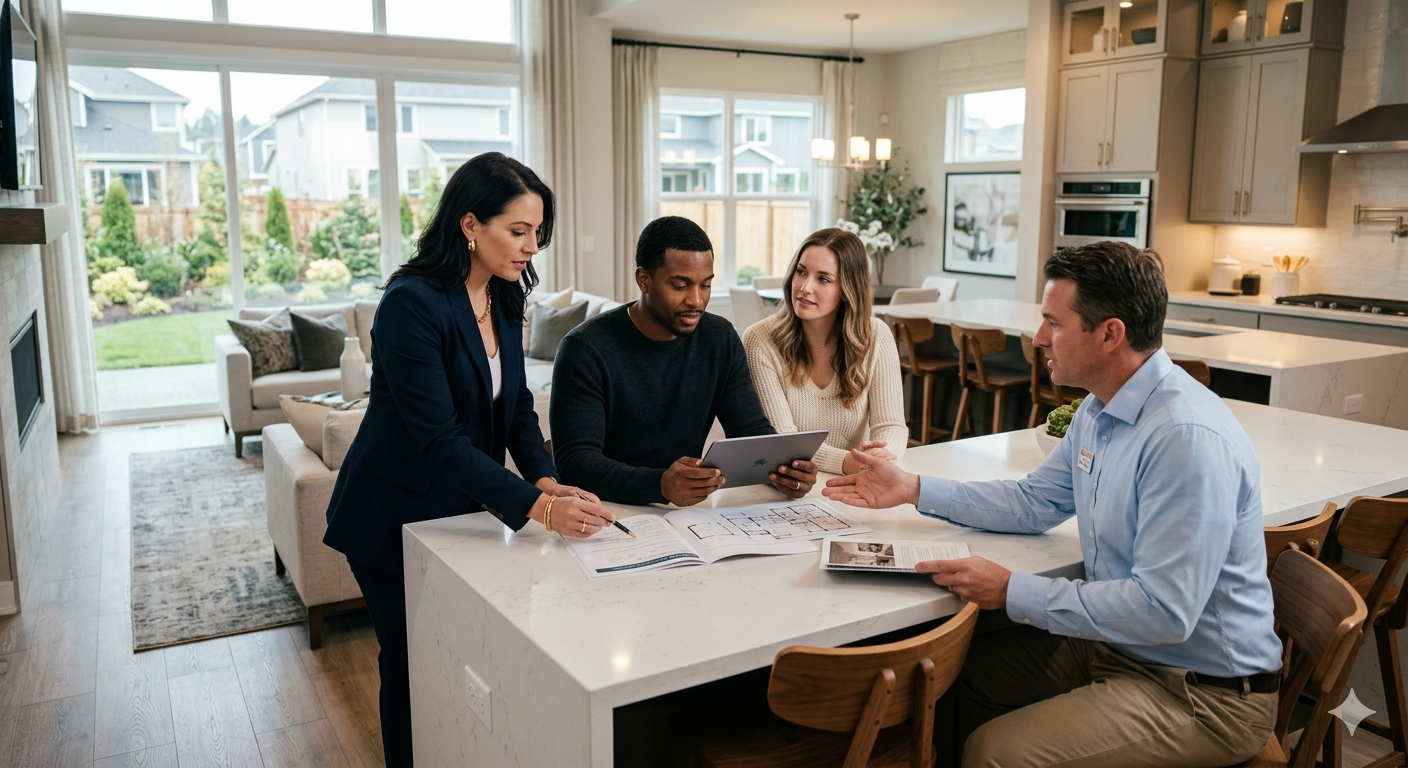
What a Buyer's Agent Actually Does in a New Construction Deal
Here is the part that surprises most buyers: bringing a buyer's agent into a new construction purchase costs you nothing. The builder pays the agent's commission. It is already built into the project's sales structure. You are not paying extra for representation. You are simply deciding whether to use a protection that is already available to you at no cost.
What that representation actually delivers is substantial. An experienced buyer's agent brings independent price analysis so you know whether the builder's pricing is competitive relative to comparable new construction in the market. They review the contract before you sign it, not after, and flag terms that put you at a disadvantage. They negotiate on upgrades, closing cost credits, and incentive packages, because there is almost always more room than the builder's initial offer suggests.
During the build process itself, a good agent stays involved. They coordinate inspection scheduling, track milestone completions, and make sure the builder is delivering what was agreed. And at the final walkthrough, they know what to look for in a way that a first-time new construction buyer simply does not.
The specific gaps buyers face without representation are real: signing contracts with unfavorable delay clauses, missing negotiating room on upgrades that could have been captured, choosing the builder's lender without comparing the actual cost, and skipping inspections because nobody told them it was an option. All of that is preventable with the right person in your corner from the beginning.
The Builder's Preferred Lender: Should You Use Them?
Builders push hard for buyers to use their preferred lender, and the incentives they attach to that push can look very attractive. Closing cost credits of several thousand dollars, free upgrade packages, and interest rate buydowns are real offers, and sometimes they are genuinely the right financial decision.
But sometimes they are not, and the only way to know the difference is to run an independent comparison before you commit.
The preferred lender relationship benefits the builder because it tightens control over the transaction. A lender that works inside the builder's ecosystem has incentive to keep the deal together for the builder's benefit as much as the buyer's. That does not mean the loan product is bad. It means you should verify independently before assuming the incentive package makes it the best overall deal.
The right way to evaluate it: get a full loan estimate from the builder's preferred lender and at least one independent lender for the same loan product. Compare the interest rate, APR, origination fees, and total closing costs side by side. Then put the builder's incentive on top of the independent lender's numbers and see which scenario actually costs less over the life of the loan. That math, not the excitement of the incentive offer, is what the decision should be based on.

Upgrades, Options, and the Trap of the Design Center
The design center appointment is one of the most enjoyable parts of the new construction process for most buyers. It is also where new construction budgets quietly explode, and where builders recoup a significant portion of their margin on homes that were priced to look accessible.
The base home price is the entry point. The design center is the profit center.
Flooring upgrades, countertop packages, lighting selections, cabinet hardware, finished basement options — every one of these is priced at a builder markup that is almost always higher than what you would pay an independent contractor post-close. That does not mean you should never upgrade through the builder. It means you should know which upgrades are worth the builder's price and which ones are not before you sit down at that table.
The general framework: upgrades that are structural, difficult to change after construction is complete, or tied to systems inside the walls, electrical, plumbing rough-ins for a future bathroom, extra outlets, are worth doing through the builder during the build process. Surface finishes that can be swapped out later, flooring, light fixtures, hardware, and paint, are almost always cheaper done post-close by independent contractors, often at half the design center price or less. Having that framework in your head before the appointment is the difference between a design center visit that stays on budget and one that adds $30,000 to your purchase price.
New Construction Inspections: Yes, You Still Need One
This is the assumption that costs new construction buyers the most: a brand new home does not need an inspection because it was just built to code.
That assumption is wrong, and it is expensive.
Municipal inspections during the construction process are real, but they are not comprehensive. Inspectors are checking for code compliance at specific milestones with limited time and limited scope. They are not doing a detailed evaluation of every system, every connection, and every finished surface in the home. Construction errors, incomplete work, and quality issues slip through municipal inspections routinely. Not because inspectors are negligent, but because the scope of what they check and the time they have to check it are not designed to deliver the level of detail a buyer needs.
The most valuable inspection a new construction buyer can do is a pre-drywall inspection, scheduled after framing, electrical, and plumbing rough-ins are complete but before the walls are closed. At that stage, an independent inspector can see everything that will be hidden once drywall goes up. Framing issues, electrical wiring shortcuts, plumbing installation problems, all of it is visible before it is sealed inside your walls. After that window closes, identifying and fixing those issues becomes exponentially more expensive.
A final independent inspection before closing is also non-negotiable. Punch list items, incomplete finishes, and system issues are all fair game for correction before you sign the closing documents, but only if you have an inspection that identifies them.
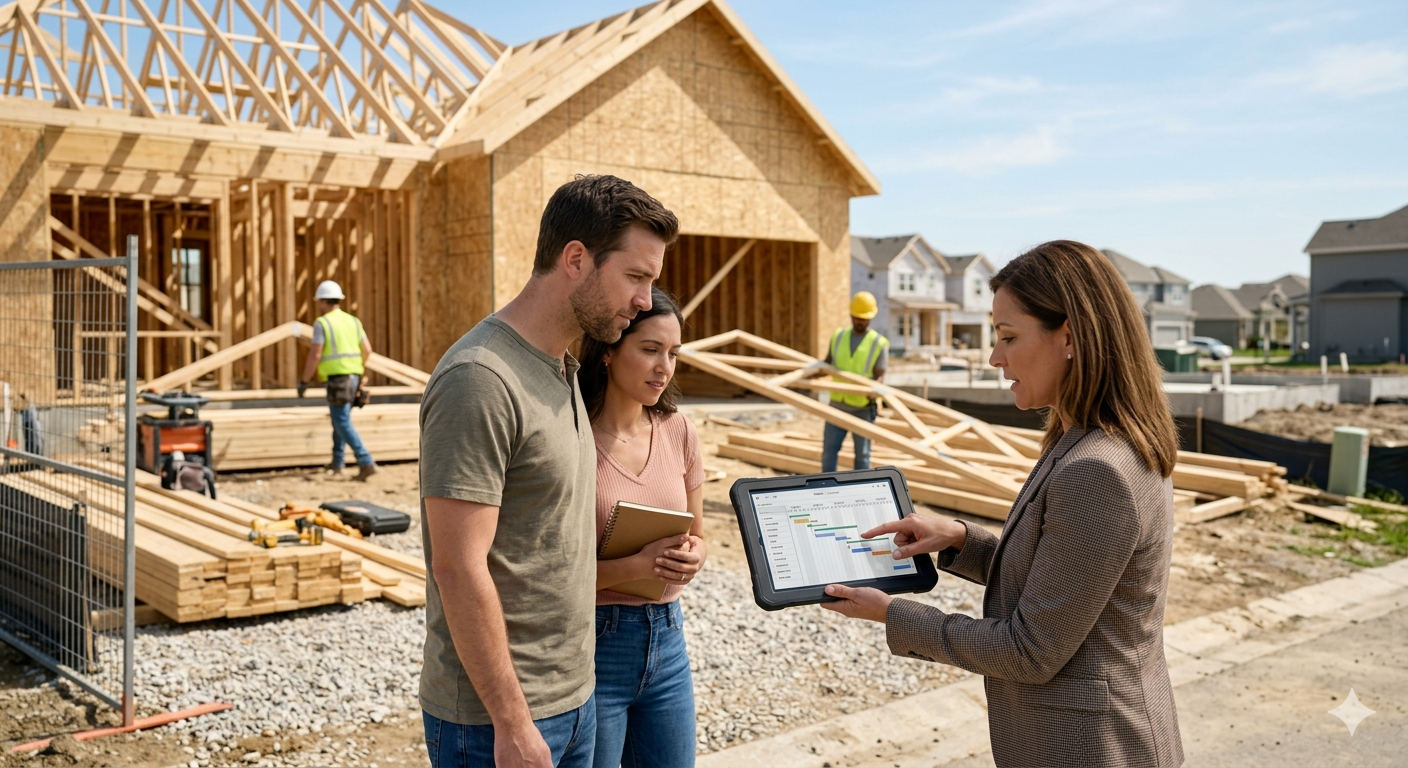
New Construction Timelines and What Can Go Wrong
A realistic new construction timeline in Liberty, MO, right now runs somewhere between six months on the shorter end for production homes with standard selections, to twelve to eighteen months for custom builds or heavily upgraded production homes with material lead times factored in.
That range matters enormously if you have a current home to sell, a lease ending on a specific date, or a school year transition to plan around. The buyers who struggle most in new construction timelines are the ones who planned around the builder's best-case estimate rather than a realistic one.
Supply chain disruptions, while less severe than the 2021 to 2023 period, are still a real variable. Specific material lead times, subcontractor availability, and permitting backlog at the municipal level all create delay risk that is largely outside the builder's control but inside the builder's contract. Before you sign, the contract language around timeline and delay protections deserves a close read. Specifically, look for what happens if the build extends significantly beyond the projected completion date, what your options are, and whether there is any compensation mechanism for extended delays.
If you are selling a current home to fund the new construction purchase, the timing coordination between your sale closing and your new construction closing is a logistics problem that needs a plan, not a hope. There are bridge solutions, and there are ways to structure the sale of your existing home to create flexibility. Understanding what your current home is worth right now is the first step in building that plan.
Liberty, MO Neighborhoods and New Home Communities Worth Knowing
Liberty, MO draws a specific buyer profile: families who want strong schools and a genuine community feel without sacrificing access to the broader Kansas City metro. Move-up buyers from the urban core who are ready for space, newer construction, and neighborhoods designed for long-term living. Professionals relocating to KC who are doing their research before they arrive and want a market with sustained value.
The new construction activity here spans a range of price points and community types. Entry-level new builds in the low $300,000s serve first-time buyers and younger families making their first move into homeownership. Mid-range production communities in the $350,000 to $500,000 range attract move-up buyers looking for modern floor plans, energy-efficient systems, and community amenities. Upper-end custom and semi-custom builds push well above that for buyers who want specific finishes, larger lots, and more individual character in the product.
Each community type has a different builder dynamic, a different contract structure, and a different negotiating environment. Knowing which type of community you are shopping in before you start is part of building the right strategy for your situation.
See how Liberty, MO, fits into the broader Kansas City neighborhood landscape and explore what other communities in the metro are offering at similar price points.
What Jason DeLong Brings to a New Construction Purchase in Liberty MO
The pitch here is proof, not promotion.
Most buyer's agents approach a new construction deal the same way they approach a resale transaction. They write an offer, they show up at closing, and they do not add much in between. That is not what a buyer in a new construction deal actually needs.
The architecture background changes the entire dynamic. Spending years training to evaluate structures, read construction documents, understand how buildings go together, and identify where design decisions create long-term problems means walking through a model home or a build-in-progress as something closer to a technical evaluation than a tour. Framing details, mechanical placements, structural decisions that will affect how the home performs for decades these are things a trained eye catches that a standard real estate walkthrough misses.
The investor mindset applied to new construction means evaluating the deal, not just the dream. That means analyzing whether the builder's pricing reflects genuine market value, whether the upgrade packages pencil out, whether the community's trajectory supports the long-term value of the purchase, and whether the contract terms are fair relative to what the market will bear.
The seller-side experience means understanding how builders think. Having been on the development and construction side of more than 100 transactions gives a perspective on where builder margin lives, where the real room to negotiate exists, and what levers actually move in a new construction deal. Builders respect buyers who come in prepared. They move for buyers who come in with someone who speaks their language.
That combination of architectural training, investor analysis, and construction experience is what makes Heartland Homes KC the right fit for a buyer in Liberty, MO, who wants more than someone to hold a door open at the model home.
And if at any point during this process the new construction path does not pencil out for your situation, knowing what your current home could bring in a cash offer is worth understanding. You can explore cash offer options here and read more about how cash offers work for Kansas City suburb sellers if flexibility on your current home is part of the equation.
Your Next Step Before You Walk Into That Model Home
New construction in Liberty, MO, is a real opportunity right now. The market is active, the builders are competing, and the conditions favor buyers who show up prepared. The buyers who regret the process are almost always the ones who got excited at the model home, signed before they fully understood what they were signing, and found out later what a more strategic approach would have looked like.
Jason DeLong at Heartland Homes KC works with new construction buyers in Liberty MO and across the Kansas City metro. No cost to you, no obligation, just a straight conversation about what the process looks like, what your leverage points are, and what a builder is not going to tell you on their own.
Schedule a call here before your next model home visit and walk in with a real plan.
Explore Kansas City neighborhoods and new communities to see the full picture of what the metro is offering right now.
Find out what your current home is worth if timing your current sale around a new construction purchase is part of the equation.
The opportunity is there. Let's make sure you capture it on the right terms.
Categories
Recent Posts



GET MORE INFORMATION

REALTOR® Lic# 2007006120 | 2000164348